Not sure what to use on your skin, or in what order? Our free skincare routine builder asks five simple questions about your skin type, sensitivity and concerns, then builds a morning and evening routine just for you. You do not need a photo or an account, and it takes about a minute.
A good routine does not need ten steps or an expensive shelf of products. It needs the right basics, in the right order, with a few well-chosen ingredients for your skin. Build your routine below, then read on to understand how it works.
Loading the routine builder…
How Our Skincare Routine Builder Works
The builder starts with the basics every skin needs: a cleanser, a moisturizer and a sunscreen. It picks textures to match your skin type, for example a gel cleanser for oily skin and a creamy cleanser for dry skin. If you have sensitive skin, it switches to fragrance-free products and gentler ingredients.
Then it adds treatments for your main concerns, such as vitamin C for dullness or niacinamide for excess oil, depending on how big a routine you want. A minimal routine keeps to the basics, a balanced routine adds one treatment, and a full routine adds up to two treatments and a weekly step.
If you are pregnant or breastfeeding, use prescription skin treatments or have a skin condition such as eczema or rosacea, the builder leaves out active ingredients and keeps the routine simple, because those situations need advice from a doctor.
The Right Order for a Skincare Routine
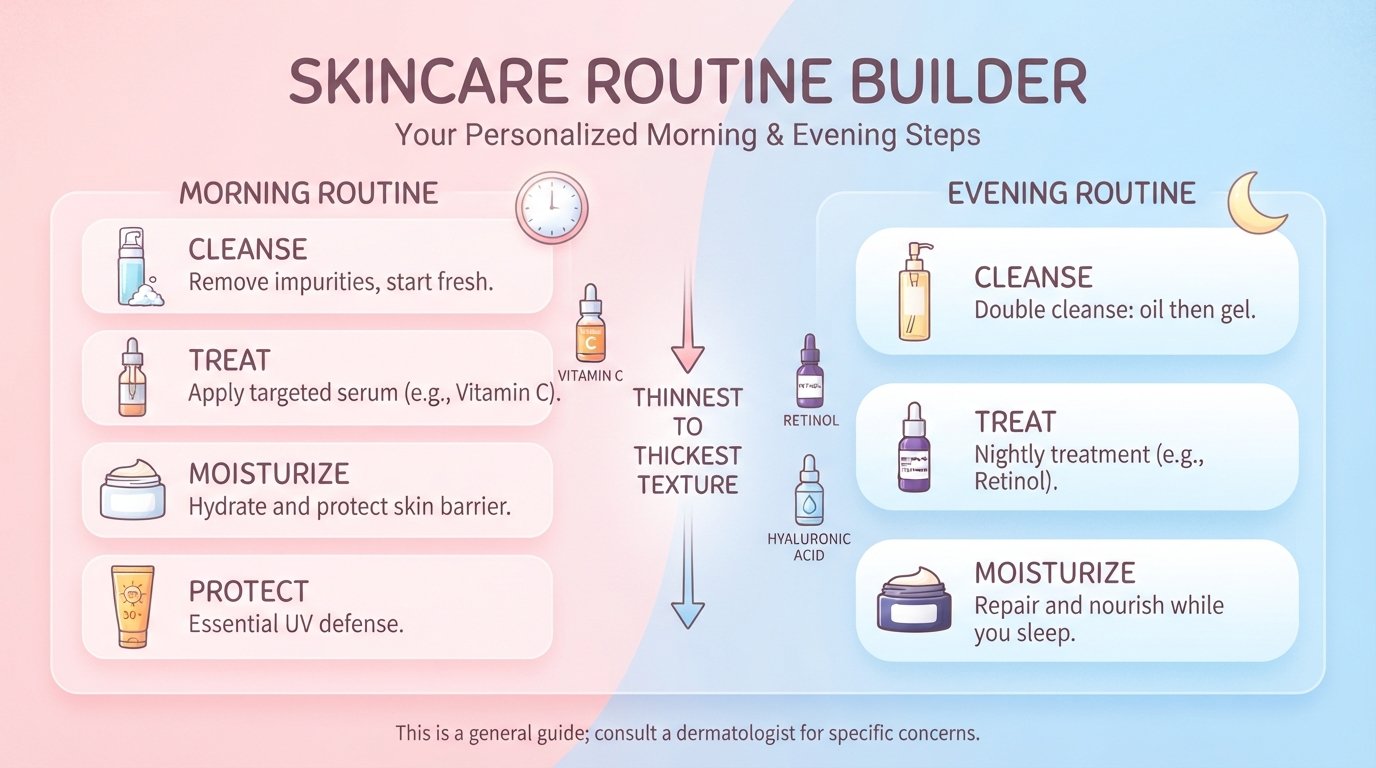
A simple rule is to apply products from the thinnest texture to the thickest, so that each step can absorb properly. Here is the usual order.
- Cleanse. Wash your face with a gentle cleanser to remove dirt, oil, sunscreen and makeup. In the morning, a quick cleanse or a rinse is often enough for dry or sensitive skin.
- Treat. Apply serums or treatments that target your concerns, such as vitamin C, niacinamide, hyaluronic acid or retinol. Apply them on clean skin, before moisturizer.
- Moisturize. Apply a moisturizer to hydrate the skin and support its barrier. Every skin type needs one, including oily skin.
- Protect (morning only). Finish your morning routine with a broad-spectrum sunscreen of SPF 30 or higher. Sunscreen is the most important step for healthy skin in the long term.
What Each Step Does
- Cleanser: Removes dirt and oil without stripping the skin. A good cleanser leaves skin clean, not tight.
- Treatment or serum: Delivers concentrated ingredients for a specific concern, such as dullness, breakouts or fine lines.
- Moisturizer: Reduces water loss and supports the skin barrier, which keeps skin comfortable and less reactive.
- Sunscreen: Protects against UV damage, which causes dark spots, uneven tone and premature lines.
Key Skincare Ingredients Explained
Here is a quick guide to the ingredients that appear most often in routines, and what they are best for.
| Ingredient | What it does | Good for | Good to know |
|---|---|---|---|
| Hyaluronic acid | Draws and holds water in the skin | Dryness and dehydration | Apply on slightly damp skin |
| Ceramides | Help support the skin barrier | Dry and sensitive skin | Often found in moisturizers |
| Niacinamide | Helps with oil, pores and uneven tone | Oily skin, pores, dark spots | Generally well tolerated |
| Vitamin C | An antioxidant that helps brighten skin | Dullness, dark spots | Best in the morning, under sunscreen |
| Salicylic acid (BHA) | Exfoliates inside the pores | Breakouts, blackheads, oily skin | Start slowly, since it can be drying |
| Retinol | Supports skin renewal | Fine lines, uneven tone | Use in the evening, start slowly |
| AHAs and PHAs | Gently exfoliate the skin surface | Dullness, rough texture | Use sparingly, and wear sunscreen |
| Peptides | Support firmer-looking skin | Fine lines, sensitive skin | A gentle option |
| Centella and panthenol | Soothe the skin | Redness and irritation | Gentle and calming |
| Zinc oxide | A mineral filter that blocks UV rays | All skin, especially sensitive | Can leave a slight white cast |
Skincare Routines by Skin Type
These are simple examples of what a routine can look like for each skin type. The builder above personalizes them based on your concerns.
Dry Skin Routine
Morning: Creamy cleanser or a water rinse, hydrating serum, rich moisturizer and sunscreen.
Evening: Creamy cleanser, hydrating serum and a richer cream to lock in moisture.
Extra tip: Use lukewarm water, since hot water can dry the skin further.
Oily Skin Routine
Morning: Gel cleanser, niacinamide serum, lightweight gel moisturizer and an oil-free sunscreen.
Evening: Gentle cleanser (twice if you wore sunscreen or makeup) and a light gel moisturizer.
Extra tip: Do not skip moisturizer. A light gel keeps skin hydrated without feeling heavy.
Combination Skin Routine
Morning: Balanced gel cleanser, a light serum, a gel-cream and sunscreen.
Evening: Gentle cleanser and a gel-cream, with extra moisturizer on dry areas.
Extra tip: Use treatments such as niacinamide on the oilier T-zone, and richer products on dry cheeks.
Normal Skin Routine
Morning: Gentle cleanser, an antioxidant serum, a light moisturizer and sunscreen.
Evening: Gentle cleanser and a light moisturizer.
Extra tip: Keep it simple, and avoid adding too many products at once.
Sensitive Skin Routine
Morning: Mild fragrance-free cleanser, a soothing moisturizer and a mineral sunscreen.
Evening: Mild cleanser and a ceramide cream.
Extra tip: Introduce one product at a time, and avoid fragrance and strong exfoliants.
How Many Steps Do You Really Need?
More steps do not mean better skin. A minimal routine of cleanser, moisturizer and sunscreen is enough for many people, and it is much easier to keep up. A balanced routine adds one treatment, such as a serum for your main concern. A full routine adds a second treatment and a weekly step, such as a gentle exfoliant or a mask.
Start with the size that you can keep up every day. A simple routine that you follow consistently works better than a complicated one that you give up after a week.
How to Add New Products Safely
- Patch test first. Apply a small amount of the new product to your inner arm or jawline for a few days. If you see redness, itching or stinging, do not use it on your face.
- Add one product at a time. If you add several products at once, you will not know which one caused a reaction, or which one is helping.
- Wait about two weeks. Give your skin time to adjust before adding the next product.
- Start slowly with actives. Ingredients such as retinol, salicylic acid and exfoliating acids should start at 1 to 2 times a week, then increase if your skin is comfortable.
- Keep retinol and exfoliating acids on different nights. Using them together can irritate the skin. A common pairing is vitamin C in the morning and retinol in the evening.
How Long Until You See Results?
Hydrating and soothing products can make skin feel better within days. Changes in oil, texture and breakouts usually take several weeks of regular use. Dark spots and fine lines take longer, often a few months, and sunscreen is what stops them from getting worse.
Because of this, it is best to judge a routine after a few weeks of consistent use, rather than changing it every few days.
Common Skincare Routine Mistakes to Avoid
- Using too many products at once. A long routine can irritate the skin and makes it hard to tell what works.
- Skipping sunscreen. Even the best serum cannot make up for daily sun exposure.
- Over-exfoliating. Scrubbing or using strong acids too often damages the skin barrier and can cause dryness, redness and breakouts.
- Copying someone else’s routine. A routine that works for a friend may not suit your skin type, sensitivity or concerns.
- Changing products too often. Skin needs weeks to respond. Switching constantly means you never learn what works.
- Ignoring irritation. Stinging, burning or lasting redness is a sign to stop and simplify.
When to See a Dermatologist
A routine can improve the look and feel of healthy skin, but it cannot treat medical skin problems. Please see a doctor or dermatologist if you have severe or painful acne, deep cysts, a rash that does not go away, signs of eczema or rosacea, a reaction that gets worse, or any mole or skin spot that changes in size, shape or color.
If you are pregnant or breastfeeding, or you use prescription skin treatments, check with your doctor before adding new active ingredients.
Skincare Routine Builder FAQ
What is a skincare routine builder?
A skincare routine builder is a tool that creates a simple skincare routine based on your answers. Our builder asks about your skin type, sensitivity, main concerns and the size of routine you want, and then gives you a morning and evening routine with ingredient tips.
In what order should I apply skincare products?
Apply products from the thinnest to the thickest texture. In the morning, the usual order is cleanser, treatment or serum, moisturizer and sunscreen. In the evening, it is cleanser, treatment or serum and moisturizer.
How many steps does my skincare routine need?
Many people do well with three steps: a cleanser, a moisturizer and a sunscreen. You can add one or two treatments for specific concerns. A simpler routine that you follow every day usually works better than a long one that you skip.
Do I need sunscreen every day?
Yes. Sunscreen protects your skin from UV damage, which causes dark spots, uneven tone and premature lines. Use a broad-spectrum sunscreen with SPF 30 or higher every morning, even on cloudy days.
Can I use retinol and vitamin C together?
Many people use vitamin C in the morning and retinol in the evening, so they are not on the skin at the same time. If your skin is sensitive, start with one and add the other slowly.
Is the skincare routine builder free, and do I need a photo?
Yes, the skincare routine builder is free and does not need a photo or an account. You simply answer five questions, and the tool runs in your browser.
What if I am pregnant or breastfeeding?
If you tell the builder that you are pregnant or breastfeeding, it leaves out active ingredients such as retinol and strong acids and gives you a simple routine. Doctors commonly advise caution with some skincare ingredients during pregnancy, so please check with your doctor or pharmacist before adding any new active product.
How long does it take to see results from a skincare routine?
Hydrating and soothing products can make a difference within days. Oil, texture and breakouts usually take several weeks of regular use, and dark spots and fine lines can take a few months. Judge a routine after a few weeks of consistent use.
This guide offers general skincare information, not medical advice. If you have painful, persistent or worsening skin problems, are pregnant or breastfeeding, or use prescription skin treatments, please speak to a doctor or dermatologist before changing your routine.