Not sure what your hair type is? Our free hair type finder asks seven simple questions and tells you whether your hair is straight, wavy, curly or coily. You do not need to upload a photo, and it takes about a minute.
Knowing your hair type makes it much easier to choose shampoo, conditioner, styling products and haircuts that work with your hair instead of against it. Take the quiz below, then read on for a complete guide to every hair type.
Loading the quiz…
What Is Hair Type?
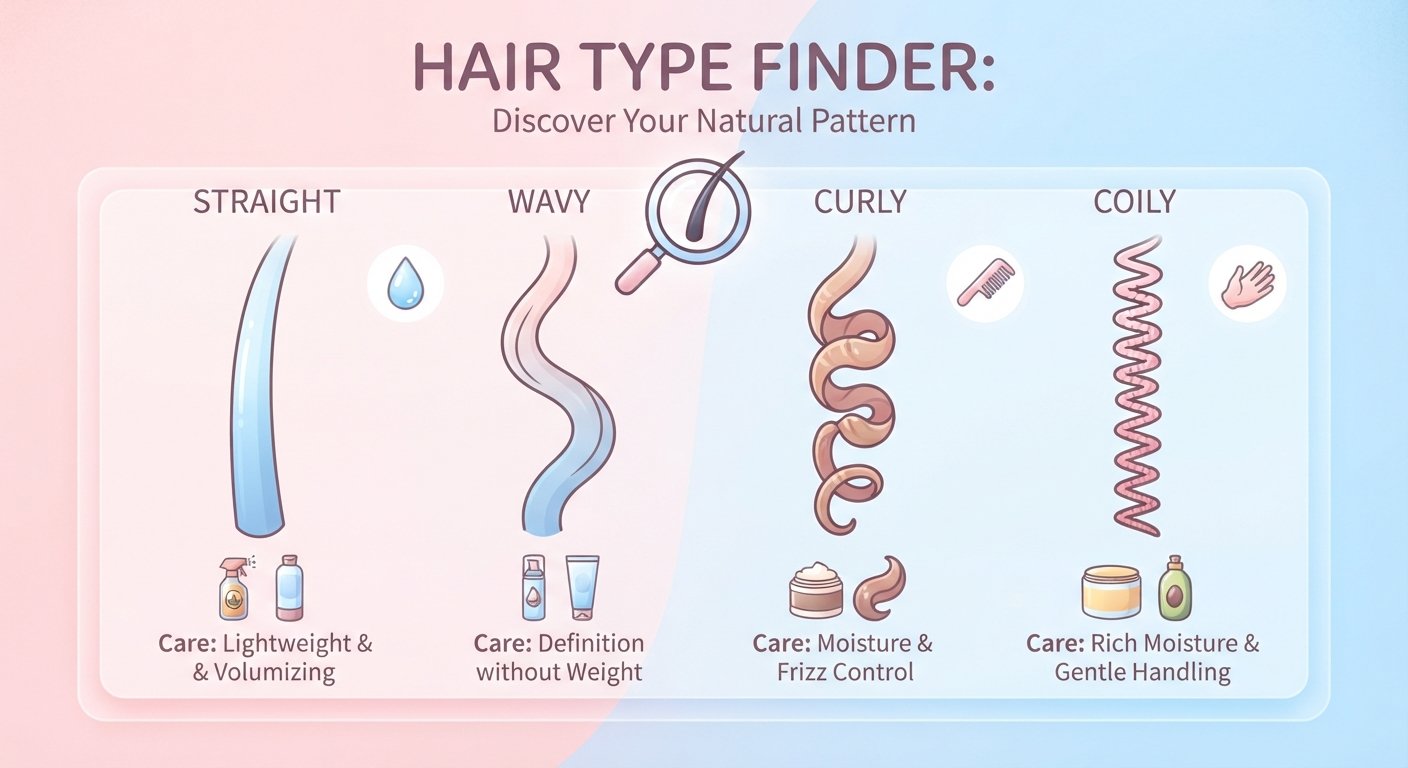
Hair type describes the natural shape of your hair strands, in other words the pattern your hair forms as it grows. The most widely used system sorts hair into four types: Type 1 is straight, Type 2 is wavy, Type 3 is curly and Type 4 is coily. Types 2, 3 and 4 are split into subtypes A, B and C, from the loosest pattern to the tightest.
This system is popular with hairstylists and in the hair care industry, but it is a guide, not a scientific rule. Many people have a mix of patterns on their head, for example waves at the back and tighter curls at the front, and that is completely normal.
How Our Hair Type Finder Works
The quiz asks about the things that reveal your natural pattern: the shape of your hair as it air-dries, the shape of a single strand, how much your hair shrinks when it dries, how quickly your roots get oily, how it reacts to humidity, how much volume it has and how easily it tangles. Each answer adds points to one or more hair types, and the type with the most points is your result.
If your answers are mixed, you will often land between two types, such as wavy and curly. That is common, and you can use tips from both. The finder is a helpful starting point, and the best judge is always how your hair behaves with the products you use.
How to Find Your Hair Type at Home
You can check your hair type at home in a few minutes. For the most reliable result, use clean hair with no products, and do not use heat.
- Wash and let hair air-dry. Wash your hair with a gentle shampoo, skip styling products and let it dry naturally. Heat and products can hide your real pattern.
- Look at the overall pattern. Once your hair is dry, look in a mirror in natural light. Does it fall straight, form loose S-shaped waves, make defined spirals, or coil tightly?
- Do the strand test. Take a single strand and lay it on a flat surface. A straight line suggests straight hair, a gentle S suggests wavy hair, a spiral suggests curly hair and a tight zigzag suggests coily hair.
- Compare wet and dry. Notice how much shorter your hair looks once it dries. Little change points to straight or wavy hair, while a lot of shrinkage points to curly or coily hair.
- Check different sections. Look at the front, sides, back and crown. Many people have different patterns in different places, so note the most common pattern.
The Four Hair Types Explained
Each type below explains what it looks like, its subtypes and how to care for it. These are guidelines to try, and your own hair is the best guide.
Straight Hair (Type 1)
What it looks like: The hair falls straight from root to tip with little or no bend. It is often shiny, because natural oil travels easily down the strand.
Subtypes: Type 1 is sometimes divided by strand thickness, from fine and thin to coarse and thick.
Care: Use lightweight products, wash as often as your scalp needs and keep conditioner away from the roots. Volumizing products and layers add body.
Ingredients to look for: Light conditioners, volumizing mousses and dry shampoo.
Go easy on: Heavy creams, butters and oils, which can make straight hair look flat and greasy.
Wavy Hair (Type 2)
What it looks like: The hair forms an S-shaped pattern that sits between straight and curly. Waves often start a little below the roots.
Subtypes: Type 2A has loose, barely-there waves. Type 2B has more defined S-shaped waves. Type 2C has deep waves that border on curls.
Care: Use light mousses or gels and scrunch them in while hair is wet. Let hair dry without touching it, to avoid frizz.
Ingredients to look for: Lightweight mousse, light leave-in conditioner and sea-salt or texturizing spray.
Go easy on: Heavy oils and rich butters that weigh waves down, and brushing dry hair.
Curly Hair (Type 3)
What it looks like: The hair forms spirals or ringlets, and it is usually full and springy. Curls can dry out and frizz easily.
Subtypes: Type 3A has loose, large curls. Type 3B has springy, tighter ringlets. Type 3C has tight corkscrews and many curls close together.
Care: Moisture is the priority. Detangle in the shower with conditioner, use a leave-in and a curl cream or gel, and scrunch hair while it is soaking wet.
Ingredients to look for: Moisturizing conditioner, leave-in conditioner, curl cream or gel and a weekly deep conditioner.
Go easy on: Harsh shampoos, brushing dry curls and too much heat.
Coily Hair (Type 4)
What it looks like: The hair forms very tight coils or zigzags, and it often looks much shorter than it really is because of shrinkage. It is delicate and tends to be dry.
Subtypes: Type 4A has tight, springy coils with a visible S-pattern. Type 4B bends in sharp zigzag angles. Type 4C has the tightest pattern and the most shrinkage.
Care: Use rich moisture and gentle handling. Detangle in small sections on damp hair with lots of conditioner, and layer a leave-in, a cream and a sealing oil or butter.
Ingredients to look for: Rich conditioners and leave-ins, shea butter and other butters, and sealing oils.
Go easy on: Tight styles that pull on the edges, detangling dry hair and frequent heat.
Hair Type Comparison Chart
Use this chart to compare the four types side by side.
| Hair type | Pattern | Shrinkage | Oil travels down | Main need | Product weight |
|---|---|---|---|---|---|
| Straight (1) | No bend | Hardly any | Very easily | Volume and light products | Lightweight |
| Wavy (2) | Loose S-shape | A little | Fairly easily | Definition without weight | Light to medium |
| Curly (3) | Spirals and ringlets | Quite a lot | With difficulty | Moisture and frizz control | Medium to rich |
| Coily (4) | Tight coils and zigzags | A lot | Rarely | Deep moisture and gentle handling | Rich |
Hair Type vs Hair Texture, Density and Porosity
Hair type is only one of four things that shape how your hair behaves, and each one answers a different question.
Hair type is the pattern of your hair: straight, wavy, curly or coily. Hair texture, sometimes called strand thickness, is how thick each single strand is, usually described as fine, medium or coarse. Hair density is how many strands you have on your head, from thin to thick. Hair porosity is how well your hair absorbs and keeps moisture.
Two people with the same hair type can need very different products if their texture, density or porosity differ. For example, fine, low-density curly hair needs lighter products than coarse, dense curly hair. It is worth knowing all four, and our hair porosity test is a good place to check the last one.
Can Your Hair Type Change?
Your natural pattern is largely genetic, but your hair can change over time. Hormonal changes such as puberty, pregnancy and menopause, some medications, age, and heat or chemical damage can all affect how your hair behaves. Some people find their hair becomes wavier, straighter or drier at different points in life.
If your hair changes suddenly or you notice a lot of shedding or thinning, it is a good idea to talk to a doctor. If the change is gradual, repeat the quiz every few months and adjust your routine.
Tips for an Accurate Hair Type Result
- Test on clean hair with no products, because products can flatten or exaggerate your pattern.
- Let your hair air-dry fully, since heat tools change the pattern.
- Check several sections of your head, not only one spot.
- Look at your hair in natural light, and compare it wet and dry.
- Use the strand test as well as the overall look, since both give clues.
- Take the quiz twice. If you get the same result both times, you can trust it.
Common Hair Type Mistakes to Avoid
- Judging your hair type after heat styling. Straighteners, curling irons and blow dryers hide your natural pattern. Always check with air-dried hair.
- Using the wrong weight of product. Heavy creams can flatten straight and wavy hair, while very light products may not give curly and coily hair enough moisture.
- Brushing curls and coils when dry. Dry brushing breaks the curl pattern and causes frizz and breakage. Detangle gently when wet, with conditioner.
- Ignoring the rest of your hair profile. Texture, density and porosity matter as much as your type. Use them together to choose products.
- Expecting one pattern everywhere. Mixed patterns are common, so treat different areas according to what they need.
Hair Type Finder FAQ
What is my hair type?
Your hair type is the natural pattern of your hair, usually described as straight, wavy, curly or coily. The quickest way to find yours is to take the hair type finder quiz on this page, or to wash your hair, let it air-dry with no products and look at the pattern.
Is the hair type finder free, and do I need a photo?
Yes, the hair type finder is free and does not need a photo or an account. You simply answer seven questions, and the quiz runs in your browser.
How accurate is the hair type quiz?
The quiz is a helpful general guide, not a scientific measurement. It depends on how you describe your own hair, so answer based on clean, air-dried hair with no products. If you are unsure, repeat it on another day.
What are the four hair types?
The four hair types are Type 1 straight, Type 2 wavy, Type 3 curly and Type 4 coily. Types 2, 3 and 4 have subtypes A, B and C, from the loosest pattern to the tightest.
Can I have more than one hair type?
Yes. Many people have a mix of patterns, such as waves at the back and curls at the front, or straight roots with wavy ends. When the quiz gives you a result between two types, use tips from both.
Can my hair type change?
Yes. Hormones, pregnancy, some medications, age, and heat or chemical damage can all change how your hair behaves. If your hair changes suddenly, or you notice a lot of shedding, speak to a doctor.
What is the difference between hair type and hair porosity?
Hair type is the shape of your hair pattern, while porosity is how well your hair absorbs and holds moisture. Any hair type can have low, medium or high porosity, so it helps to know both.
How do I choose products for my hair type?
Match the weight of the product to your hair. Straight and fine hair usually does best with lightweight products, wavy hair with light to medium products, and curly and coily hair with richer, moisturizing products. Texture, density and porosity also matter, so adjust based on how your hair responds.
This guide offers general hair care information, not professional or medical advice. If you notice hair loss, scalp pain or irritation, or sudden changes in your hair, please see a doctor or dermatologist.