Not sure what your undertone is? Our free skin undertone finder asks seven simple questions and tells you whether your undertone is warm, cool or neutral. You do not need a photo or an account, and it takes about a minute.
Knowing your undertone helps you choose foundation, blush, lipstick, hair color, jewelry and clothes that make your skin glow instead of looking washed out. Take the quiz below, then read on for a full guide.
Loading the quiz…
What Is Skin Undertone?
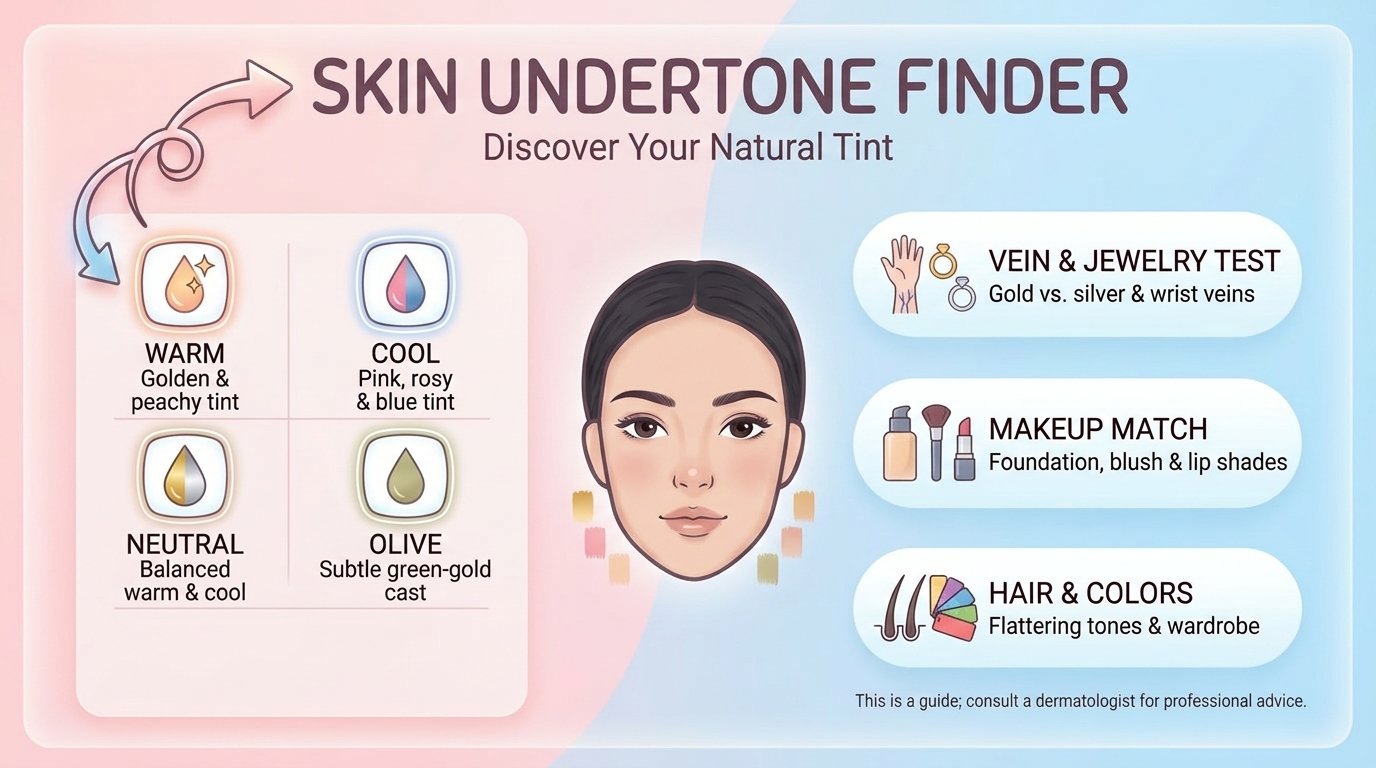
Skin undertone is the subtle color beneath the surface of your skin. It is the soft tint that stays the same even when your skin gets lighter or darker, for example after sun exposure. The three main undertones are warm, cool and neutral.
People often mix up undertone with skin tone. Skin tone, sometimes called depth, describes how light or deep your skin is, from very fair to very deep. Undertone describes the tint beneath it. Two people with the same skin depth can have completely different undertones, which is why a foundation that matches your depth can still look wrong.
A third term you may see is overtone, which is the visible surface color of your skin, including redness, tan or freckles. Overtone can change with the seasons, while your undertone stays largely the same.
How Our Skin Undertone Finder Works
The quiz uses the clues stylists and makeup artists commonly use to find an undertone: how your wrist veins look, which jewelry metal suits you, how white and cream colors look against your face, the natural tint of your skin and which colors flatter you. Each answer adds points to warm, cool or neutral, and the one with the most points is your result.
Some clues are stronger than others. The jewelry, color and natural tint questions count the most, while sun reaction counts only a little, because it depends heavily on your skin depth and sun exposure rather than undertone.
The finder is a style guide, not a scientific test. If your answers are very mixed, a neutral result is common and perfectly normal.
How to Find Your Undertone at Home
You can double-check the quiz with a few simple tests. Do them in natural daylight, near a window, with a clean face and no makeup, since artificial lighting changes how colors look.
- The vein test. Look at the veins on the inside of your wrist. Blue or purple veins suggest a cool undertone, green veins suggest a warm undertone, and a mix of both suggests a neutral undertone. This test works best on fair to medium skin, since veins can be hard to see on deeper skin tones.
- The jewelry test. Hold a gold item and a silver item against your skin. If silver looks brighter and more flattering, you are probably cool. If gold looks better, you are probably warm. If both work, you are probably neutral.
- The white and cream test. Hold a sheet of pure white paper beside your face, then a cream or off-white one. Cool undertones usually look best against pure white, while warm undertones usually look best against cream.
- The color test. Hold fabrics or scarves in a few colors, such as emerald green and rust orange, up to your face. The shades that make your skin look brighter and your eyes clearer point to your undertone.
- The foundation swatch test. Swipe three foundation shades labeled cool, neutral and warm along your jawline. The one that seems to disappear into your skin in daylight is the closest match to your undertone.
Warm, Cool and Neutral Undertones Explained
Each undertone below explains the signs to look for and which makeup, hair colors and jewelry tend to flatter it. These are guidelines to try, not strict rules.
Warm Undertone
Common signs: Greenish veins, a yellow, golden or peachy tint, gold jewelry that looks better than silver, and cream tones that look better than stark white.
Makeup: Peach and coral blush, warm reds, brick and terracotta lipstick, and bronze, copper and gold eyeshadow.
Hair color: Golden brown, honey blonde, copper, auburn and caramel highlights.
Jewelry and clothes: Yellow and rose gold, with olive, rust, mustard and warm red clothing.
Cool Undertone
Common signs: Blue or purple veins, a pink, rosy or bluish tint, silver jewelry that looks better than gold, and pure white that looks fresher than cream.
Makeup: Pink, rose and berry blush, raspberry, plum and blue-red lipstick, and silver, taupe and navy eyeshadow.
Hair color: Ash brown, cool brown, platinum blonde and blue-black or burgundy tones.
Jewelry and clothes: Silver, white gold and platinum, with emerald, royal blue, ruby and lavender clothing.
Neutral Undertone
Common signs: A mix of blue and green veins, both gold and silver looking good, and a skin tint that is hard to call warm or cool.
Makeup: Soft rose-peach blush, rosy nude, mauve and true red lipstick, and most neutral eyeshadows.
Hair color: Medium brown, chestnut, beige blonde, and most other shades, warm or cool.
Jewelry and clothes: Gold, silver and mixed metals, with soft and muted colors as well as bold ones.
Olive Undertone
What it is: Olive is a variation with a subtle green or gray-gold cast. It is often grouped with neutral or warm undertones, and it can be confusing because it does not look clearly pink or yellow.
Tips: Look for foundation labeled olive or golden neutral. Warm earthy colors, such as olive, bronze, terracotta and deep emerald, often look especially good.
Skin Undertone Comparison Chart
Use this chart to compare the three undertones side by side.
| Undertone | Wrist veins | Best metal | White or cream | Makeup shades |
|---|---|---|---|---|
| Warm | Greenish | Gold | Cream looks better | Peach, coral, brick, bronze |
| Cool | Blue or purple | Silver | Pure white looks better | Pink, berry, plum, silver |
| Neutral | A mix | Gold and silver | Both look fine | Rose-peach, mauve, true red |
Undertone vs Skin Tone: What Is the Difference?
Skin tone is how light or deep your skin is. Undertone is the tint beneath it. You can think of skin tone as the depth of the paint, and undertone as the color of the paint.
When you buy foundation, you need both: a shade with the right depth, and a shade with the right undertone. A shade that is the right depth but the wrong undertone often looks orange, pink, gray or ashy.
Can Your Undertone Change?
Your undertone stays largely the same throughout your life, even though the surface color of your skin changes. Sun exposure can make your skin look darker or more golden, and winter can make it look paler or pinker.
If you tested your undertone when you were very tanned or very pale, repeat the tests in natural daylight at a time when your skin looks like itself. Redness from irritation or breakouts can also hide your true undertone.
How to Choose Foundation for Your Undertone
- Test on your jawline. Swatch two or three shades in a line from the cheek down to the neck, and look at them in daylight. The best shade looks like it disappears.
- Check the label, but trust your eyes. Brands name undertones differently, so a shade labeled neutral in one brand may look warm in another.
- Watch for warning signs. If a shade looks orange, it is probably too warm. If it looks pink or ashy, it is probably too cool.
- Match your neck, not only your face. A foundation that matches your face but not your neck can leave a visible line.
- Wait a few minutes. Foundation can darken slightly as it dries and reacts with your skin, so check the shade again after a few minutes.
Tips for an Accurate Undertone Result
- Test in natural daylight, not under yellow or fluorescent lights.
- Remove makeup first, because foundation and blush hide your natural tint.
- Avoid wearing bright clothes during the test, since colors reflect onto your skin.
- Use more than one test. Veins, jewelry, white paper and color tests together are more reliable than any single one.
- Check your skin when it is not sunburned, tanned or irritated.
- Take the quiz twice. If you get the same result both times, you can trust it.
Common Undertone Mistakes to Avoid
- Confusing undertone with skin depth. Fair skin is not always cool, and deep skin is not always warm. Every depth can have any undertone.
- Relying only on the vein test. Veins can be hard to see, and they can look different depending on your skin depth and lighting. Use several tests.
- Judging under artificial light. Yellow bulbs can make anyone look warm, and blue-white lights can make anyone look cool.
- Using sun reaction as the main clue. How you tan depends on your skin depth and genetics rather than undertone, so treat it only as a small hint.
- Treating the result as a strict rule. If a color from another group makes you feel great, wear it. The result is a starting point, not a limit.
Skin Undertone Finder FAQ
What is my skin undertone?
Your skin undertone is the subtle tint beneath the surface of your skin, and it is warm, cool or neutral. The quickest way to find yours is to take the skin undertone finder quiz on this page, or to try the vein, jewelry and white paper tests in natural daylight.
Is the skin undertone finder free, and do I need a photo?
Yes, the skin undertone finder is free and does not need a photo or an account. You simply answer seven questions, and the quiz runs in your browser.
How accurate is the undertone quiz?
The quiz is a helpful general guide, not a scientific measurement. It combines several common clues, but it depends on how you describe your skin. For the best result, answer in natural daylight and with no makeup on.
What is the difference between undertone and skin tone?
Skin tone is how light or deep your skin is. Undertone is the subtle warm, cool or neutral tint beneath the surface. People with the same skin tone can have different undertones.
Can my undertone change?
Your undertone stays largely the same, although the surface color of your skin can change with sun, seasons and irritation. If you are unsure, test again when your skin is at its natural color.
What if I get a neutral result?
A neutral result is very common. It means your skin has a balance of warm and cool tints, so you can wear a wide range of colors, and both gold and silver often suit you.
What is an olive undertone?
Olive is a variation with a subtle green or gray-gold cast. It is often grouped with neutral or warm, and foundations labeled olive or golden neutral often match it well.
Does undertone matter for hair color?
It can help. Warm undertones often suit golden, honey and copper shades, cool undertones often suit ash and cool shades, and neutral undertones can wear most colors. Treat it as a guide rather than a rule, and consider your skin depth and eye color too.
This guide offers general style suggestions only. Undertone advice is a guideline, not a rule, so wear whatever makes you feel confident and comfortable.