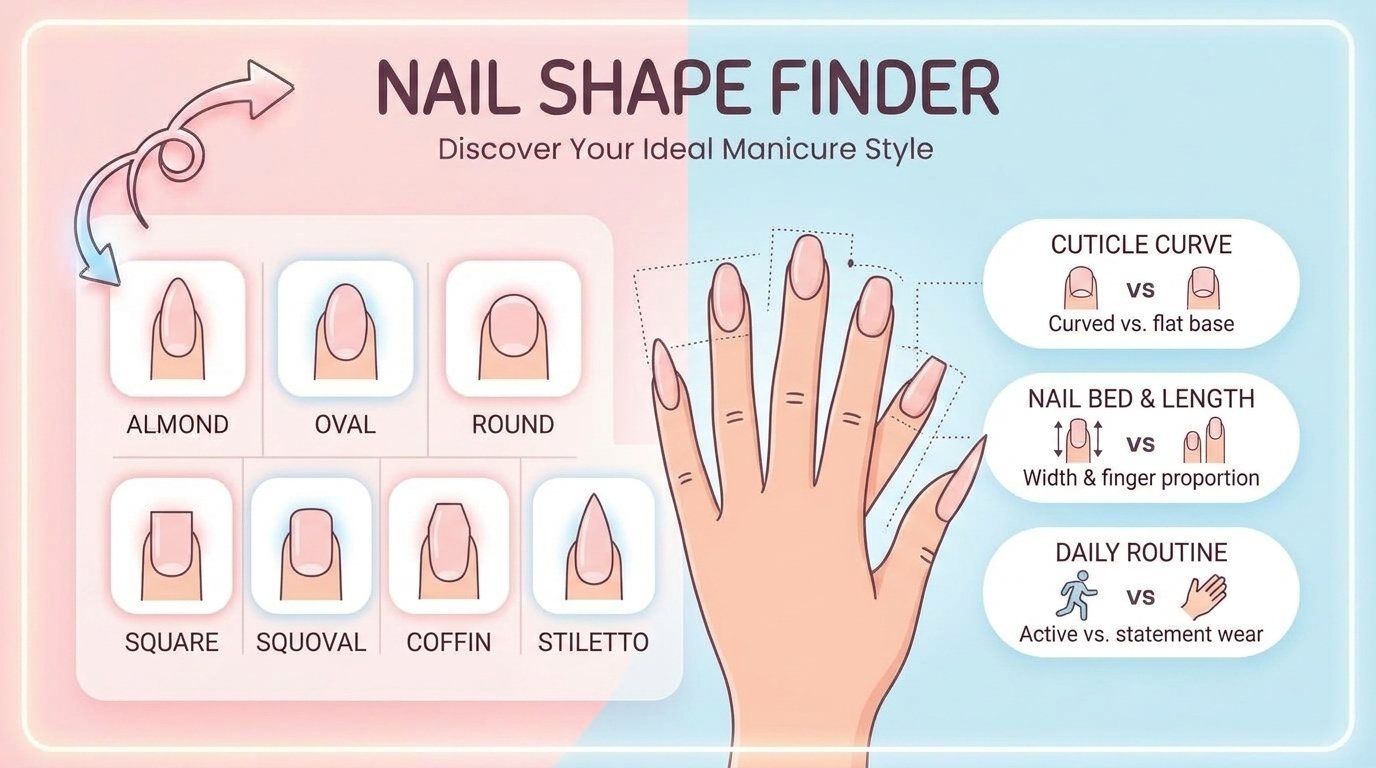
Wondering which manicure style suits your hands best? Our free nail shape finder asks seven simple questions about your nail beds, finger length, nail strength and daily routine to recommend your ideal match—whether that is almond, oval, round, square, squoval, coffin or stiletto. You do not need to upload a photo, and it takes less than a minute.
Choosing the right nail shape does more than make your polish look neat; it visually elongates your fingers, prevents breakage and keeps your manicure comfortable for everyday tasks. Take the quiz below to find your signature shape, then explore our complete nail shape guide, comparison chart and shaping tips.
Loading the nail shape quiz…
What Determines Your Best Nail Shape?
Choosing the right nail shape comes down to four key details: the curve of your cuticle line, the width of your nail beds, the length of your fingers and the strength of your nails. While any shape can technically be filed onto your hands, the most flattering silhouettes create visual harmony with your natural anatomy.
Nail technicians often use the “mirror rule”—matching the curve of your free edge to the curve of your cuticle base. For example, a rounded U-shaped cuticle pairs naturally with oval, round or almond tips, while a flatter, straighter cuticle base blends seamlessly with square or squoval shapes.
How Our Nail Shape Finder Works
Our interactive nail shape quiz evaluates the exact factors professional nail artists look at during a consultation. It weighs your cuticle geometry, nail bed width, finger proportions, preferred nail length, natural nail durability and daily hand activity. Each answer awards weighted points across seven classic and modern nail shapes, surfacing the silhouette that offers the best balance of beauty and wearability.
If two shapes score closely—such as almond and oval, or round and squoval—the tool also highlights your runner-up match so you can switch effortlessly depending on your nail length or mood.
How to Analyze Your Nails at Home Before Shaping
Before picking up an emery board, take one minute to examine your bare hands in bright, natural daylight:
- Remove old polish and push back cuticles gently. Seeing your bare nail plate reveals the true shape of your cuticle base and sidewalls.
- Check your cuticle curve. Look at the base of your ring and middle fingers. Decide whether the base forms a soft arch (curved) or a flatter horizontal line (straight).
- Measure your nail bed proportions. Notice whether your nail plate looks long and narrow or short and wide. Wider nail beds generally look slimmer with tapered shapes like almond or oval.
- Assess your free-edge thickness. Gently press the tip of your nail. If it bends easily, stick with shorter, curved edges like round or squoval unless you plan to wear builder gel or acrylics.
- Consider your dominant hand’s daily workload. Heavy typing, kitchen prep, weightlifting or healthcare work call for smooth, snag-free edges that will not catch or split at the corners.
The Seven Popular Nail Shapes Explained
Every nail silhouette creates a distinct visual effect on the hands. Use the breakdown below to explore how each shape looks, who it flatters most and how to style it.
Almond Nails
Key features: Slender sidewalls that taper inward toward a soft, rounded peak, resembling the silhouette of an actual almond.
Best for: Medium-to-long nails, wider nail beds and shorter fingers that benefit from a slimming, lengthening illusion.
Filing tip: File both sides evenly at a 45-degree angle toward a centered point, then gently round off the tip so it stays smooth rather than sharp.
Style match: Sheer milky nudes, glazed donut pearl finishes and curved micro-French tips.
Oval Nails
Key features: Straight lower sidewalls that curve smoothly into a rounded, egg-like tip without sharp angles or dramatic points.
Best for: Short-to-medium and medium lengths, curved cuticles and anyone seeking an elegant, finger-elongating look with lower breakage risk than almond.
Filing tip: Mirror the exact arch of your cuticle bed at the free edge for a balanced, natural proportion.
Style match: Classic crimson reds, glossy neutrals and minimalist negative-space designs.
Round Nails
Key features: Short free edge that follows the natural curved contour of the fingertip with no corners or tapering.
Best for: Short natural nails, fragile or peeling nails and active lifestyles involving typing, sports or hands-on work.
Filing tip: Keep sidewalls straight until they reach the fingertip, then shape the tip into a neat semicircle.
Style match: Rich dark polishes (burgundy, espresso, navy) and clean-girl sheer pinks.
Square Nails
Key features: Straight, parallel sidewalls meeting a crisp, flat horizontal tip at 90-degree corners.
Best for: Long, slender fingers, narrow nail beds and sturdy natural nails or gel overlays.
Filing tip: Hold your file completely perpendicular to the tip for a clean straight line, then give the outer corners two light passes with a buffer to stop snagging.
Style match: Iconic 90s white French tips, bold solid colors and geometric nail art.
Squoval Nails
Key features: A hybrid of square and oval—combining a flat, straight center tip with softly beveled, rounded corners.
Best for: Almost every hand shape, finger length and cuticle type, making it the safest universally flattering manicure.
Filing tip: Shape a classic square first, then angle your file at 45 degrees at the outer corners just enough to soften the edges.
Style match: Soft pastels, cat-eye velvet shades and modern micro-French manicures.
Coffin (Ballerina) Nails
Key features: Sharply tapered, straight sidewalls that narrow inward and end in a crisp, squared-off flat tip—resembling either a coffin or a ballerina’s pointe shoe.
Best for: Long or extra-long extensions (acrylic, hard gel, Gel-X) and narrow-to-medium nail beds.
Filing tip: Taper both sides symmetrically from the stress point upward, then flatten the top edge cleanly at 90 degrees.
Style match: Baby boomer ombré fades, 3D chrome accents and statement nail art.
Stiletto Nails
Key features: Dramatic, steeply tapered sidewalls converging into a sleek, sharp point.
Best for: Long extensions sculpted with acrylic or hard gel when you want maximum finger elongation and bold editorial style.
Filing tip: Mark the center of the tip first and file straight lines from each sidewall to meet cleanly at the apex point.
Style match: High-shine chrome, dramatic dark tones and intricate hand-painted designs.
Nail Shape Comparison Chart
Compare all seven nail shapes side by side by required length, durability and visual effect on your hands.
| Nail shape | Ideal length | Best cuticle & finger type | Durability | Visual effect |
|---|---|---|---|---|
| Almond | Medium to long | Curved cuticles; short fingers or wide beds | Moderate (best with gel) | Slims and elongates fingers |
| Oval | Short-medium to medium | Curved cuticles; most finger lengths | High | Soft, graceful lengthening |
| Round | Short | Any cuticle; wide beds or active hands | Very high | Clean, natural and neat |
| Square | Short-medium to medium | Flat cuticles; long, slim fingers | Moderate (corners can snag) | Crisp, modern and bold |
| Squoval | Short to medium | All cuticles and finger proportions | High | Balanced and universally flattering |
| Coffin | Long to extra-long | Tapered or narrow beds; extensions | High (with enhancement) | Dramatic, trendy elongation |
| Stiletto | Long to extra-long | Extensions only; statement style | Low-moderate (tip care needed) | Maximum length and high drama |
Essential Nail Filing & Shaping Tips
- Choose the right grit file. Use a 180-grit or 240-grit emery board or glass file for natural nails. Coarse 100-grit files are meant only for acrylic or hard gel enhancements and can shred natural keratin layers.
- File in one direction. Sawing back and forth creates micro-tears along the free edge that lead to peeling and splitting.
- Shape with old polish on first. If your nails are uneven, rough out the silhouette while old polish is still on—the color makes it easier to judge length symmetry before removing it for fine buffing.
- Protect your stress points. Avoid filing deeply into the lower sidewalls where the nail leaves the skin; weakening this area causes painful side cracks.
- Check symmetry from both angles. Look at your nails with fingers extended away from you and curled toward your palm so every tip matches.
Common Nail Shaping Mistakes to Avoid
- Forcing almond or coffin shapes onto very short nails. Without enough free edge, tapering too early narrows the nail plate awkwardly and weakens the sidewalls. Start with oval or squoval while your length grows out.
- Skipping top coat on the free edge. Wrapping polish and top coat across the very tip seals the edge against water and prevents corner chipping.
- Using metal nail clippers on dry, brittle nails. Clipping flattens the natural C-curve abruptly and can split the nail plate; file gradually instead, or trim only after a warm shower.
- Ignoring your daily hand habits. If you type eight hours a day or lift weights, sharp square corners or long stiletto tips will feel frustrating within days.
Nail Shape Finder FAQ
What is the most universally flattering nail shape?
Squoval and oval are widely considered the most universally flattering nail shapes. Squoval balances straight and curved lines to suit nearly any finger length or cuticle shape, while oval adds gentle elongation without needing long extensions.
Which nail shape makes short fingers look longer?
Almond and oval nail shapes create the strongest lengthening illusion for short fingers. Their tapered, curved sidewalls draw the eye vertically and make both the nail bed and finger appear more slender.
What nail shape is strongest and least likely to break?
Round and squoval are the strongest shapes for natural nails because they have no sharp corners or narrow points to snag on clothing, keyboards or everyday objects.
What is the difference between squoval and square nails?
Square nails have straight sidewalls and sharp 90-degree corners with a flat top edge. Squoval nails keep the same flat top edge, but the outer corners are softly rounded so they look gentler and resist chipping.
What is the difference between coffin and ballerina nails?
Coffin and ballerina nails share almost the exact same silhouette: tapered sidewalls ending in a flat, squared-off tip. Nail artists sometimes call slightly straighter sidewalls “coffin” and subtly curved sidewalls “ballerina,” though the two terms are used interchangeably in most salons.
Can I get almond or coffin nails on short natural nails?
True almond and coffin shapes require at least a medium free edge so the sidewalls can taper gracefully without cutting into your nail bed. If your nails are currently short, choose round or oval while they grow, or ask your nail tech for builder gel or soft-gel extensions.
How do I know if my nail beds are wide or narrow?
Look at your bare nail from the top down. If the nail plate spans almost the entire width of your fingertip from side to side with very little skin visible around the edges, you have wide nail beds. If noticeable skin borders both sides of a slender nail plate, you have narrow nail beds.
Should I match my nail shape to my cuticle shape?
Matching your tip shape to your cuticle curve is one of the easiest ways to get a balanced manicure. If your cuticle base forms a rounded U-shape, oval, round or almond tips will look seamless. If your cuticle line is flatter across the base, square or squoval shapes create natural symmetry.
This guide provides general manicure and nail styling advice only. Always sanitize nail tools, avoid over-filing the natural nail plate, and consult a doctor or dermatologist if you experience persistent nail pain, lifting, discoloration or signs of infection.