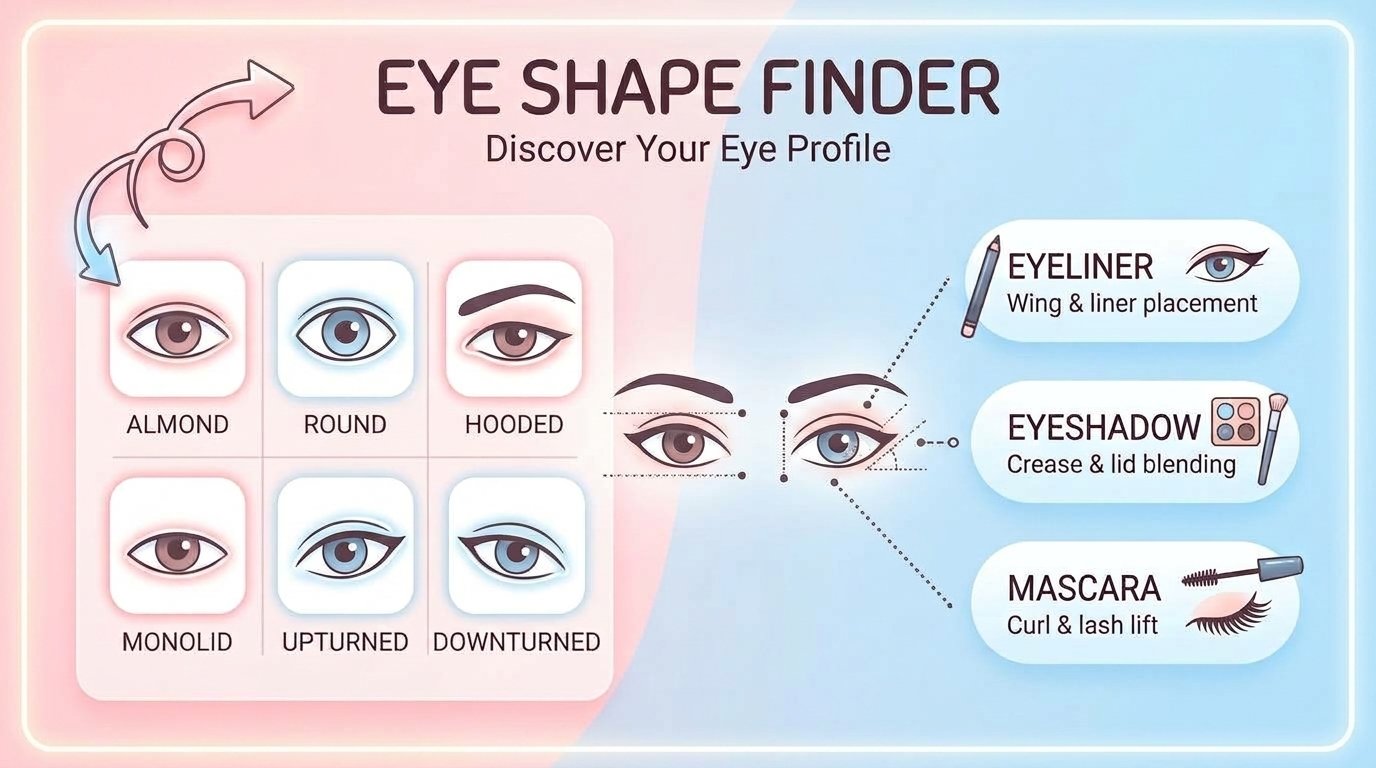
Not sure what your eye shape is? Our free eye shape finder asks seven simple questions and tells you whether your eyes are almond, round, hooded, monolid, upturned or downturned. You do not need to upload a photo, and it takes about a minute.
Knowing your eye shape makes it much easier to choose eyeliner, eyeshadow placement and mascara techniques that make your eyes stand out. Take the quiz below, then read on for a complete guide to every eye shape.
Loading the quiz…
What Determines Your Eye Shape?
Eye shape depends on several features that work together: the outline of the eye, whether you have a visible crease in the eyelid, how much of the iris (the colored part) shows, and how the outer corner sits compared with the inner corner. The amount of eyelid you can see when your eyes are open also matters.
Eye shape is not the same as eye color or eye spacing. You can have almond eyes that are close-set or wide-set, and you can have hooded eyes of any color. It helps to think about both the shape and the spacing when you plan your makeup.
How Our Eye Shape Finder Works
The quiz asks about the clues makeup artists look at: whether you have a visible crease, how much of your iris shows, whether your outer corners lift or droop, the outline of your eyes, how they look when relaxed, and what happens to eyeshadow when your eyes are open. Each answer adds points to one or more eye shapes, and the shape with the most points is your result.
If two shapes score close together, the result also mentions your second shape. That is common, because eye shapes often overlap, for example almond eyes with an upturned outer corner, or hooded eyes with a downturned shape. The finder is a style guide, not a medical test.
How to Find Your Eye Shape at Home
You only need a mirror and good light. Do this with no makeup on, and with your eyes open and relaxed, looking straight ahead.
- Stand in front of a mirror in natural light. Hold your head level and look straight at your reflection. Pull your hair back so it does not cover your eyes.
- Check for a crease. With your eyes open, see whether a crease is visible above your lashes. A clear crease points to almond, round, upturned or downturned eyes. A hidden crease points to hooded eyes, and no crease points to monolid eyes.
- Look at the iris. If you can see white above or below the iris, your eyes are likely round. If your lids lightly touch the iris at the top and bottom, they are likely almond.
- Check the corners. Imagine a line from the inner corner to the outer corner. If the outer corner is higher, your eyes are upturned. If it is lower, they are downturned.
- Check the spacing. The space between your eyes is usually about one eye width. If it is much smaller, your eyes are close-set. If it is much larger, they are wide-set.
The Six Eye Shapes Explained
Each shape below explains how to recognize it and which eyeliner, eyeshadow and mascara techniques tend to flatter it. These are guidelines to try, not strict rules.
Almond Eyes
Key features: Almond eyes are slightly pointed at the inner and outer corners, with the upper and lower lids lightly touching the iris. The shape is balanced and a crease is usually visible.
Eyeliner: A thin line or a soft wing both work well. Tightlining the upper waterline adds depth.
Eyeshadow: Almost any placement suits almond eyes. Try a lighter shade on the inner corner and a darker shade on the outer corner.
Mascara: Curl your lashes and coat them evenly. Both natural and dramatic lashes look good.
Round Eyes
Key features: Round eyes are large and circular, and you can often see a little white above or below the iris. They look wide, bright and open.
Eyeliner: Extend the liner outward at the outer corner to add length, and keep it thinner at the inner corner.
Eyeshadow: Place the darkest shade on the outer corner and blend it outward. Keep the center of the lid lighter.
Mascara: Put more mascara on the outer lashes to elongate the eye.
Hooded Eyes
Key features: A fold of skin covers part or all of the crease, so the lid looks smaller when your eyes are open. This is common, and it often becomes more noticeable with age.
Eyeliner: Apply a thin line close to the lashes with your eyes open, so you can see how it looks. Wing it slightly upward.
Eyeshadow: Place crease color slightly above your natural crease so it shows when your eyes are open. Matte shades in the crease and a soft shimmer on the lid add dimension.
Mascara: Curl your lashes well and use a smudge-proof formula, since the fold can cause transfer.
Monolid Eyes
Key features: Monolid eyes have smooth lids with no visible crease, or a very small one. The lid is flat and the shape looks sleek.
Eyeliner: A thin line or a graphic liner both look striking. A slightly upward wing adds a lift.
Eyeshadow: Use a gradient technique, darker next to the lashes and lighter higher up, blended well to create depth.
Mascara: Curl the lashes gently and choose a curl-holding, waterproof mascara.
Upturned Eyes
Key features: The outer corners sit higher than the inner corners, which gives a lifted, cat-like look.
Eyeliner: Follow the natural lash line and extend the wing straight out instead of steeply upward, so you do not over-lift the shape.
Eyeshadow: Add a medium shade along the lower outer lash line to balance the lift.
Mascara: Apply mascara evenly on the upper and lower lashes.
Downturned Eyes
Key features: The outer corners sit slightly lower than the inner corners, which gives a soft, gentle look.
Eyeliner: Wing the liner upward and outward from the outer corner to lift the eye, and keep the lower outer lash line light.
Eyeshadow: Blend the shade up and out toward the end of the brow, and keep the darkest shade on the upper outer lid.
Mascara: Curl the lashes and focus mascara on the outer upper lashes for lift.
Eye Spacing and Depth: More Features to Consider
Shape is only part of the picture. Spacing and depth also change which makeup techniques look best on you.
Close-Set Eyes
What it is: The distance between your eyes is less than one eye width.
Tips: Use lighter shades on the inner corners and darker shades on the outer corners to create the look of more space.
Wide-Set Eyes
What it is: The distance between your eyes is more than one eye width.
Tips: Use darker shades toward the inner corners and blend the outer corners softly to bring the eyes visually closer together.
Deep-Set Eyes
What it is: The eyes sit deeper in the socket, under a prominent brow bone.
Tips: Use light and shimmery shades on the lid to bring the eyes forward, and avoid very dark shades all over the lid.
Eye Shape Comparison Chart
Use this chart to compare the six shapes side by side.
| Eye shape | Crease | Corners | Key feature | Eyeliner idea |
|---|---|---|---|---|
| Almond | Visible | Slightly lifted, balanced | Lids lightly touch the iris | Thin line or soft wing |
| Round | Visible | Level | White shows above or below the iris | Wing outward, thin inside |
| Hooded | Hidden by a fold | Varies | Lid looks smaller | Thin line close to the lashes |
| Monolid | None or small | Varies | Smooth, flat lid | Thin or graphic liner |
| Upturned | Visible | Outer corner higher | Lifted, cat-like look | Wing straight out |
| Downturned | Visible | Outer corner lower | Soft, gentle look | Wing upward and outward |
Can Your Eye Shape Change?
Your basic eye shape is largely set by genetics and stays much the same through life. However, the way your eyes look can change. As you age, the skin around the eyes can loosen, which can make the crease less visible and give eyes a more hooded look. Puffiness, tiredness and water retention can also change how your lids look from day to day.
If you notice a sudden change in your eyelids, such as drooping, swelling or changes in vision, it is a good idea to speak to a doctor or eye specialist.
Tips for an Accurate Eye Shape Result
- Test with no eye makeup on, since liner and shadow change how the eye looks.
- Look straight into the mirror with your eyes open and relaxed, not wide open or squinting.
- Use natural light, which shows the crease and iris more clearly.
- Check both eyes. Many people have slightly different eyes, and that is normal.
- Do not tilt your head, because tilting changes how the corners and crease look.
- Take the quiz twice. If you get the same result both times, you can trust it.
Common Eye Makeup Mistakes to Avoid
- Testing makeup with your eyes closed. Eyeshadow can look perfect with your eyes closed and disappear when they are open. Check your look with your eyes open, especially if you have hooded or monolid eyes.
- Using the same technique as someone with a different shape. A tutorial for almond eyes may not work for hooded or monolid eyes. Look for techniques that match your shape.
- Applying heavy liner all the way around the eye. A thick ring of liner can make eyes look smaller, especially round and hooded eyes.
- Skipping eyelash curling. Curling lashes opens the eye on every eye shape and helps mascara hold.
- Treating the result as a strict rule. If a look you love is not on the recommended list, wear it anyway. The result is a starting point, not a limit.
Eye Shape Finder FAQ
What is my eye shape?
Your eye shape is the outline and structure of your eyes, including the crease, the angle of the corners and how much of the iris shows. The six common shapes are almond, round, hooded, monolid, upturned and downturned. The quickest way to find yours is to take the eye shape finder quiz on this page.
Is the eye shape finder free, and do I need a photo?
Yes, the eye shape finder is free and does not need a photo or an account. You simply answer seven questions, and the quiz runs in your browser.
How accurate is the eye shape quiz?
The quiz is a helpful general guide, not a medical or scientific measurement. It depends on how you describe your eyes, so answer looking straight into a mirror with no makeup. If you are unsure, repeat the quiz on another day.
What is the most common eye shape?
There is no reliable single figure for this, and it varies between people and regions. Almond eyes are often described as the most balanced shape, but every eye shape is common and beautiful.
Can I have more than one eye shape?
Yes. Eye shapes often overlap, such as almond eyes with an upturned outer corner, or hooded eyes with a downturned shape. If your quiz shows two shapes, use tips from both.
What is the difference between hooded and monolid eyes?
Hooded eyes have a crease, but a fold of skin covers it when the eyes are open. Monolid eyes have no visible crease, or a very small one, so the lid looks smooth and flat.
Can my eye shape change with age?
Your basic shape stays much the same, but the skin around the eyes can loosen with age, which can make the crease less visible and give a more hooded look. If you notice sudden drooping or swelling, speak to a doctor or eye specialist.
How do I choose eyeliner for my eye shape?
A good starting point is to match the liner to your shape. Wing the liner outward for round eyes, upward and outward for downturned eyes, and straight out for upturned eyes. Hooded and monolid eyes often look best with a thin line close to the lashes, applied with the eyes open.
This guide offers general makeup suggestions only. Eye makeup advice is a guideline, not a rule. Always use eye-safe products, remove makeup before sleeping, and see a doctor or eye specialist if you have eye pain, irritation or changes in your vision.