Not sure whether your hair is low, medium or high porosity? Our free hair porosity test asks seven simple questions and tells you how well your hair absorbs and holds on to moisture. You do not need to upload a photo or cut your hair, and it takes about a minute.
Hair porosity explains why some products work beautifully on your hair while others just sit on top or disappear in a day. Take the quiz below, then read on for a complete guide to hair porosity and how to care for each type.
Loading the quiz…
What Is Hair Porosity?
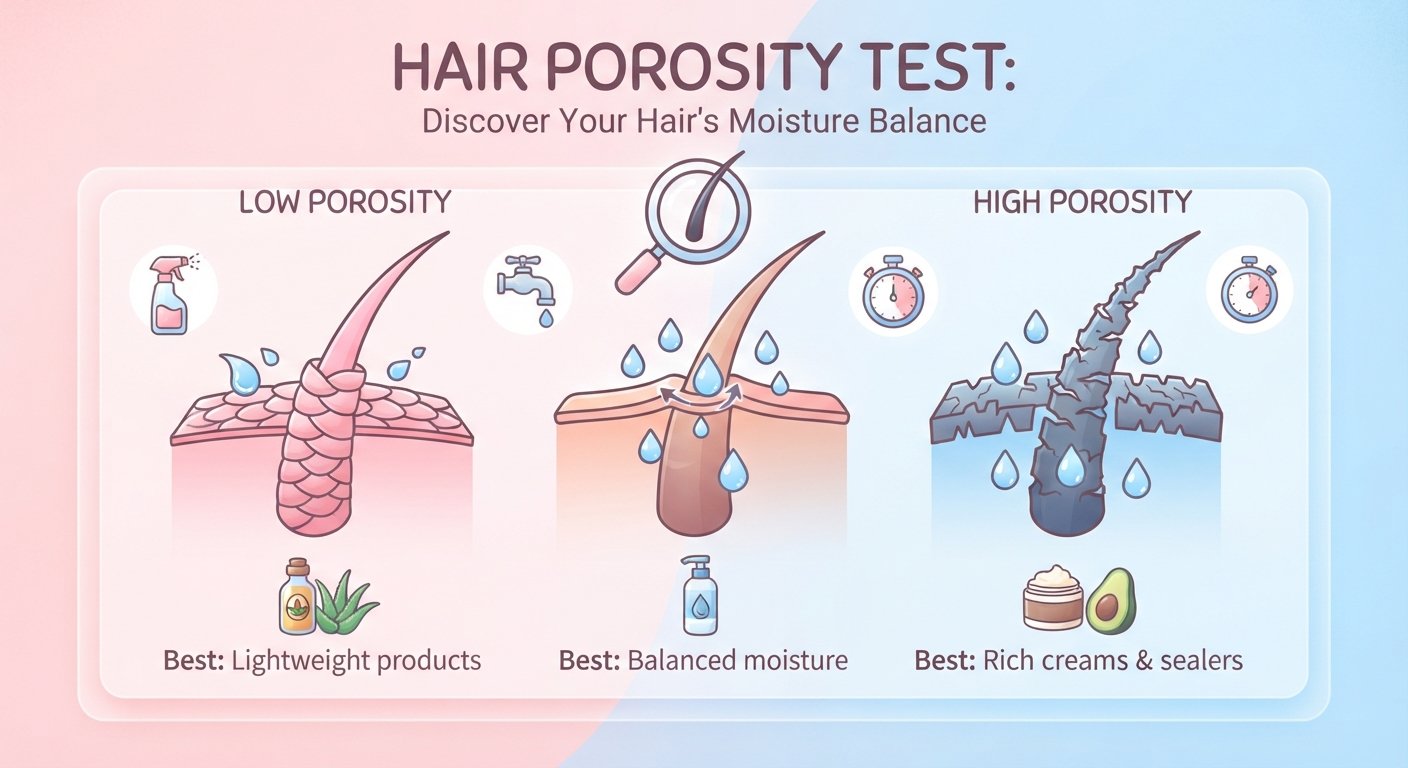
Hair porosity is your hair’s ability to absorb and keep moisture. It depends on the cuticle, the outer layer of each strand, which is made of tiny overlapping scales, a bit like roof tiles.
When the cuticle lies flat and tight, water and products find it hard to get in, and that is low porosity. When the cuticle is slightly raised, moisture goes in and stays, and that is medium porosity. When the cuticle is very raised or has gaps, moisture goes in fast and escapes just as fast, and that is high porosity.
Porosity is different from hair type. Straight, wavy, curly and coily hair can all have any level of porosity, so it is worth knowing both. Porosity is one of the most useful things to know when choosing shampoos, conditioners, oils and styling products.
How Our Hair Porosity Test Works
The quiz asks about the real-life signs of porosity: how long your hair takes to dry, whether products absorb or sit on top, how a strand feels when you slide your fingers along it, how your hair reacts to water and humidity, and how much heat or chemical treatment it has had. Each answer adds points to one or more porosity levels, and the level with the most points is your result.
If two levels score close together, the result also mentions your second level. That is common, because many people have mixed porosity, with healthy roots and damaged ends.
The test is a helpful guide, not a lab measurement. It gives you a good starting point, and the best final judge is always how your own hair responds to products.
How to Test Your Hair Porosity at Home
You can double-check your result at home with a few simple tests. Use clean hair with no products on it, so that residue does not change the result.
- The strand test. Take a single clean, dry strand and hold it at the tip. Slide your fingers slowly up the strand toward the scalp. If it feels smooth, your porosity is likely low to medium. If you feel bumps or roughness, it is likely higher. Check a few strands from different parts of your head.
- The spray bottle test. Spray a small section of clean, dry hair with water. If the water beads up and sits on the hair, porosity is likely low. If the hair absorbs the water in a moment, it is probably medium. If it soaks up the water almost instantly and feels drenched, it is likely high.
- The wash-and-dry timing test. Notice how long your hair takes to air-dry after a normal wash. Very slow drying suggests low porosity, average drying suggests medium, and very quick drying suggests high porosity.
- The product absorption test. Apply a little conditioner or lightweight oil to damp hair. If it sits on top and feels greasy, you probably have low porosity. If it soaks in and your hair feels soft, you likely have medium porosity. If your hair feels dry again soon, it is probably high.
You may have heard of the float test, where you drop a strand in a glass of water and see whether it floats or sinks. It is very popular online, but it is not very reliable. Product residue, oils and the surface tension of the water can all change the result, so use it only as a rough hint alongside the tests above.
Low, Medium and High Porosity Hair Explained
Each level below explains what it means, the signs to look for, how to care for it, and which ingredients tend to help. These are general guidelines to try, and your own hair is the best guide.
Low Porosity Hair
What it means: The cuticle lies flat and tight, so water and products have a hard time getting in. Low porosity hair is often naturally smooth and shiny, tends to repel water and takes a long time to get wet and to dry.
Common signs: Products tend to sit on top of the hair instead of absorbing, hair can feel greasy or weighed down, and product buildup is common. Hair may resist chemical treatments and color, because the cuticle is closed.
How to care for it: Use warm water and lightweight, water-based products, and apply them to damp hair. Heat helps lift the cuticle, so warm your deep conditioner with a warm towel or a hooded dryer. Use a clarifying shampoo from time to time to remove buildup.
Ingredients to look for: Aloe vera, glycerin, and lightweight oils such as argan, jojoba and grapeseed.
Go easy on: Heavy butters, thick oils and heavy protein treatments, which can sit on the hair and make it stiff or limp.
Medium Porosity Hair
What it means: The cuticle is slightly raised, so hair absorbs moisture easily and holds on to it. Medium porosity, also called normal porosity, is the most balanced level, and hair usually looks shiny and healthy.
Common signs: Hair holds styles well, takes color well, dries in an average time and rarely feels very dry or greasy. It is generally easy to manage.
How to care for it: Keep your routine simple and balanced. Use a regular conditioner, deep condition every couple of weeks and use a heat protectant before styling. Add a light protein treatment now and then if hair feels limp.
Ingredients to look for: Balanced moisturizing conditioners, light oils and heat protectant sprays.
Go easy on: Too much heat, frequent bleaching or coloring, and harsh chemical treatments, which can raise the cuticle and push hair toward high porosity.
High Porosity Hair
What it means: The cuticle is very raised or has gaps and holes. Hair soaks up water quickly but loses it just as fast, so it often feels dry, rough or frizzy. High porosity can be natural, but it often comes from heat, bleach, color or other damage.
Common signs: Hair dries very quickly, tangles easily, frizzes in humid weather and can look dull. Products absorb in seconds, but the effect does not last.
How to care for it: Layer your products to lock moisture in: a water-based leave-in first, then a cream, then an oil or butter to seal. Rinse with cool water to help smooth the cuticle, deep condition regularly and use a protein or bond-building treatment now and then.
Ingredients to look for: Shea butter and other rich butters, heavier oils such as olive and avocado, leave-in conditioners and hydrolyzed proteins.
Go easy on: Frequent bleaching, regular high heat and harsh, stripping shampoos. Very light products used alone may not be enough.
Hair Porosity Comparison Chart
Use this chart to compare the three levels side by side.
| Porosity | Cuticle | Drying time | Product absorption | Common signs | Best product weight |
|---|---|---|---|---|---|
| Low | Flat and tight | Very slow | Sits on top | Buildup, takes time to wet | Lightweight |
| Medium | Slightly raised | Average | Absorbs well | Healthy, easy to manage | Balanced |
| High | Raised or gaps | Very fast | Absorbs, then escapes | Dry, frizzy, tangles | Richer creams and butters |
What Causes High or Low Hair Porosity?
Your natural porosity is largely set by genetics, which means some people are born with low porosity and others with higher porosity.
Porosity can also change over time. Heat styling, bleaching, coloring, relaxing, frequent brushing of wet hair, harsh shampoos, sun exposure and hard water can all raise the cuticle and increase porosity. This is why the ends of long hair are often more porous than the roots, which are newer and less damaged.
You cannot permanently close a damaged cuticle, but you can protect it. Reducing heat, using gentle products, using a heat protectant and deep conditioning regularly all help hair look and feel healthier.
Tips for an Accurate Hair Porosity Result
- Test on clean hair with no products, so residue does not affect the result.
- Check several sections of your hair, including the roots, lengths and ends, since porosity can differ across your head.
- Use more than one test. The strand test, spray test and product absorption test together give a more reliable picture.
- Do not rely only on the float test, which is easily affected by residue and oils.
- Retest every few months, especially after coloring, bleaching or a long period of heat styling.
- Pay attention to how your hair responds to products, because that is the best test of all.
Common Hair Porosity Mistakes to Avoid
- Using heavy butters on low porosity hair. Thick butters and oils can sit on top of tightly closed cuticles and cause buildup. Choose lightweight products and apply them to damp, warm hair.
- Using only light products on high porosity hair. Very light products may absorb and disappear quickly. Layer a leave-in, a cream and a sealing oil to hold moisture in.
- Trusting only the float test. It is popular but often unreliable. Use several tests and watch how your hair behaves.
- Overdoing protein. Too much protein can make hair stiff and brittle, especially low porosity hair. Use it occasionally and watch how your hair feels.
- Skipping clarifying shampoo. If you use lots of products, buildup can make hair feel heavy and block moisture. A gentle clarifying shampoo once or twice a month can help, especially for low porosity hair.
- Ignoring heat and chemical damage. Heat and bleach raise the cuticle. Use a heat protectant, lower the temperature of your tools and space out chemical treatments.
Hair Porosity Test FAQ
What is hair porosity?
Hair porosity is how well your hair absorbs and keeps moisture. It depends on the cuticle, the outer layer of each strand. Low porosity means a tight cuticle that resists moisture, medium porosity is balanced, and high porosity means a raised cuticle that absorbs moisture fast but loses it fast.
How do I know my hair porosity?
The quickest way is to take the hair porosity test quiz on this page. You can also check at home with the strand test, the spray bottle test and by noticing how long your hair takes to dry and how it absorbs products.
Is the hair porosity test free, and do I need a photo?
Yes, the hair porosity test is free and does not need a photo or an account. You simply answer seven questions, and the quiz runs in your browser.
Is the float test accurate?
The float test is popular, but it is not very reliable. Oils, product residue and the surface tension of the water can all affect whether a strand floats or sinks. Use it only as a rough hint, and rely on the quiz and other tests.
Can hair porosity change?
Yes. Your natural porosity is mostly genetic, but heat, bleach, color, harsh shampoos and rough handling can raise the cuticle and increase porosity over time. Many people have healthier roots and more porous ends.
Can I have more than one porosity?
Yes. Mixed porosity is common, for example low porosity roots with high porosity ends after bleaching or heat damage. If your quiz shows two levels, use tips from both and pay attention to how different parts of your hair behave.
Is hair porosity the same as hair type?
No. Hair type describes the shape of your strands, such as straight, wavy, curly or coily. Porosity describes how well your hair absorbs moisture. Any hair type can have low, medium or high porosity.
What products are best for low porosity hair?
Low porosity hair usually does best with lightweight, water-based products such as aloe vera and light oils like argan, jojoba or grapeseed. Apply them on damp, warm hair, and use a clarifying shampoo now and then to prevent buildup.
This guide offers general hair care information, not medical or professional advice. If you notice hair loss, scalp pain or irritation, or sudden changes in your hair, please see a doctor or dermatologist.